

Global Partnership for Poverty and Entrepreneurship webinar examines faith as a motivator and source of purpose in venture creation. Professors Brett R. Smith and Mitchell J. Neubert, Miami University and Baylor University, respectively, join Dr. Mike Morris for a discussion about faith-related belief and its impact on decision-making and resiliency for entrepreneurs building businesses to move themselves out of poverty.

Bennett Freeman, a leader in human rights and business and current fellow with the UK-based Chatham House think tank, discusses the implications for corporate policy and strategy and the potential consequences for security and sustainability principles in light of global tectonic shifts in international relations and corresponding shifts in U.S. foreign policy. How are multinational corporations navigating this turbulent geopolitical landscape?

How does a historic auto manufacturer embrace sustainability and successfully transition to a post-fossil fuel era? What are the unique challenges and opportunities presented by such a dramatic transformation? In a discussion with the CEO of Ford Motor Company, South Africa, Jeff Nemeth '82, explored how one of the world's largest automakers is transforming its future and the challenges that come with it.
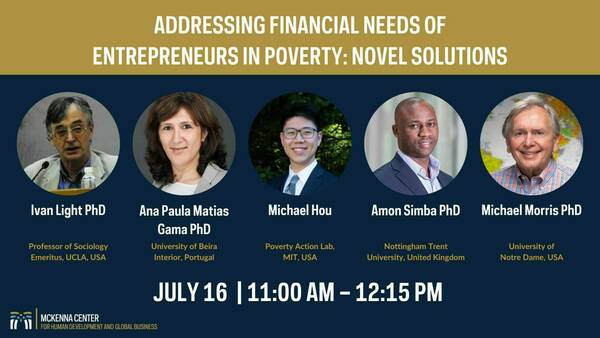
Access to finance is frequently cited as the biggest obstacle to successful venture creation by those from poverty circumstances. Whether this is actually true, or if other factors perhaps can sometimes play a bigger role, there is no question that the funding available to most entrepreneurs in poverty conditions is grossly inadequate. On July 16, 2024, this international panel explored the financial needs of low-income and disadvantaged entrepreneurs, alternative ways those needs are currently being addressed, and where the most significant gaps tend to lie. Key reasons for these gaps are discussed. Attention is devoted to identifying alternative sources of money and approaches to financing these ventures. New, innovative solutions are proposed.

Entrepreneurship, in its many forms, offers much potential to address significant global social challenges. Yet, there are also unique challenges in applying entrepreneurial thinking in differing contexts.
On Tuesday, April 9, 2024 we welcomed Luvuyo Rani to speak on the power of entrepreneurship. Luvuyo was born under apartheid and in poverty in the Eastern Cape Province of South Africa. Driven by values instilled by his mother, he went on to complete his education and pursue his dream of bringing computer literacy to the tens of millions of South Africans living in poverty-stricken townships. Luvuyo, a co-founder and CEO of Silulo Ulutho Technologies, built his company from a single location in Khayelitsha to 50 stores in townships and rural areas in the Western and Eastern Cape and 200 centers where people can access online government services and receive computer training. Core to his journey has been his passionate efforts to uplift others, particularly youth, through entrepreneurship.
Following Luvuyo's presentation, joined a panel discussion featuring four amazing entrepreneurs who are using entrepreneurship to improve the world.
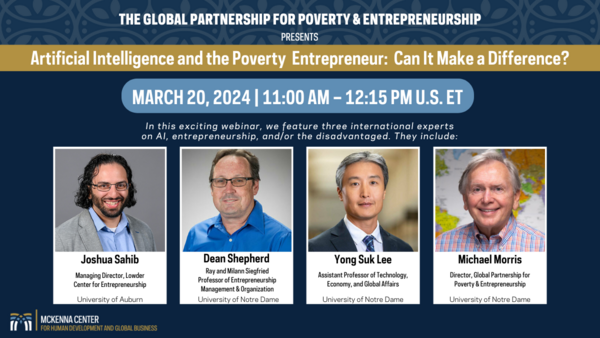
On Wednesday, March 20, 2024, we hosted a Global Partnership for Poverty & Entrepreneurship Webinar: Artificial Intelligence and the Poverty Entrepreneur: Can It Make a Difference? Revolution in artificial intelligence has been hailed as the driver of the fourth industrial revolution, a game changer, and transformative. It has also been perceived to be a source of bias, social manipulation, job loss, market volatility, socioeconomic inequality, weakening ethics, and a threat to privacy. In this webinar, we explored its positive and negative implications for those in poverty when trying to start a business, featuring three international experts on AI and entrepreneurship.
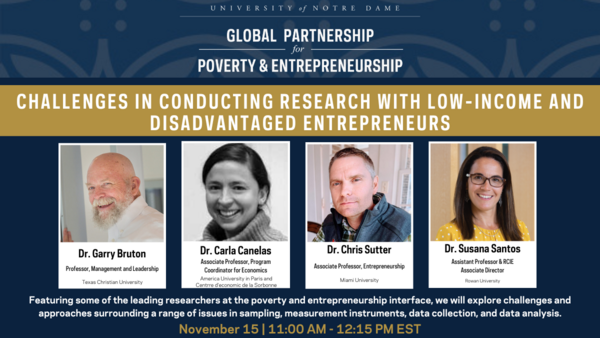
On Wednesday, November 15th, we hosted a Global Partnership for Poverty & Entrepreneurship Webinar: Challenges in Conducting Research with Low-Income and Disadvantaged Entrepreneurs. We explored challenges and approaches surrounding a range of issues in sampling, measurement instruments, data collection, and data analysis with panelists Dr. Garry Bruton (Texas Christian University), Dr. Carla Canelas (American University in Paris), Dr. Chris Sutter (Miami University), and Dr. Susana Correia Santos (Rowan University).
Dr. Gary Gereffi ’70, Emeritus Professor of Sociology and Director of Global Value Chains Center at Duke University, led two important discussions during his visit on November 16-17. In the first, “Rethinking Global Business and Its Role in National Security & Global Development,” Dr. Gereffi explored topics that may impact globalization in the future, including the impact of COVID-19, climate change, the rise of China on global trade markets, the re-emergence of industrial policy in the U.S., the role the U.S. government plays in shaping the production goals and priorities of major corporations at the national and regional levels, and the relationship between national markets and national security policies. This conversation provided a critical forum for faculty and students as the school reflects on the place of business-related themes, research, and courses in the Keough School. In the second, “Bridging the Gap Between Business, National Security, and Sustainable Development in the 21st Century”, Dr. Gereffi focused on the potential role schools of global affairs could have in addressing the reach of business and private finance in their identity and curricula on sustainable development.

Dr. Gary Gereffi is Emeritus Professor of Sociology and Director of the Center on Globalization, Governance & Competitiveness at Duke University, where he teaches courses in economic sociology, globalization, and comparative development, and international competitiveness.
Recognized as one of the founders of the Global Value Chains (GVC) framework, Dr. Gereffi has worked closely with large corporations such as Maersk Group, Nike, Walmart, and Patagonia to evaluate their sustainable development and environmental impact strategies. He has also worked with the International Labor Organization, the World Trade Organization, and the World Bank – as well as non-governmental organizations such as Oxfam and the Environmental Defense Fund – to design and evaluate programs of inclusive and sustainable development that continue to evolve through the current era of trade wars and the U.S. electoral cycle.
Dr. Gereffi has published extensively on economic development and business-government relations in various parts of the world. He is best known for his sociological research and writing on the emergence of global supply chains, a relatively new field of research in which Gary has been a pioneer.
VIEW DR. GEREFFI'S FULL CV | VIEW DR. GEREFFI'S BRIEF CV & BIO
2023 - “Navigating 21st Century Industrial Policy,” Columbia FDI Perspectives, September 16, No. 366.
2023 - “How to Make Global Supply Chains More Resilient,” Columbia FDI Perspectives, January 9, No. 348.
2023 - “Using the Global Value Chain Framework to Analyse and Tackle Global Environmental Crises” (Valentina De Marchi and Gary Gereffi). Journal of Industrial and Business Economics, 50, 1: 149-159.
2022 - China’s New Development Strategies: Upgrading from Above and from Below in Global Value Chains (Gary Gereffi, Penny Bamber, and Karina Fernandez-Stark, co-editors). Singapore: Palgrave-Macmillan.
2019 - “Introduction to the Handbook on Global Value Chains” (Stefano Ponte, Gary Gereffi and Gale Raj- Reichert). Pp. 1-27 in Stefano Ponte, Gary Gereffi and Gale Raj-Reichert (eds.), Handbook on Global Value Chains (Cheltenham, UK: Edward Elgar Publishing).
The materials below relate directly to the topics covered in this episode and complement the guided listening index:
2021 - “Increasing resilience of medical supply chains during the COVID-19 pandemic.” Industrial Analytics Platform@UNIDO.org. d
2020 - [VIDEO] Covid-19 and medical supply shortages
2020 - "What does the COVID-19 pandemic teach us about GVCs? The case of medical supplies," Journal of International Business Policy
2020 - "Coronavirus Consequences on Global Value Chains," Strategic Management Society
2020 - "An integrative typology of global strategy and global value chains: The management and organization of cross-border activities," Global Strategy Journal
2020 - [VIDEO] Medical Trade Wars: The search for drugs, devices and PPE
2020 - [VIDEO] COVID-19 and Global Supply Chains: Disruptions and Restructuring
2022 - “On the Road to Global Value Chains: How Industry Dynamics Reshaped Global Value Chains.” In M. Kipping, T. Kurosawa, and D.E. Westney (eds)., Oxford Handbook of Industry Dynamics, online access at https://academic.oup.com/edited-volume/38852.
2020 - Shaping Sustainable Supply Chains: Hosted by the German Development Institute, the podcast investigates multiple societal dilemmas arising in global supply chains and offers insights into evidence-based solutions to shift towards more sustainable and fair global supply chains. Watch this quick video for more about this episode
2020 - "Global value chains: A review of the multi-disciplinary literature," Journal of International Business Studies
2019 - "Global value chains and international development policy: Bringing firms, networks and policy-engaged scholarship back in," Journal of International Business Policy
2018 - Global Value Chains and Development (Cambridge University Press)
2014 - Duke GVC Summit: The Duke GVC Summit brought together leading international organizations, government agencies, and NGOs, along with several dozen academics, practitioners, and policymakers from 12 countries who were thought leaders and experts on GVCs. Of note are the keynote address by Pascal Lamy, Director-General of the World Trade Organization, and interviews with Mr. Lamy and Anabel Gonzalez, former Trade Minister of Costa Rica and Senior Director of the World Bank's Trade and Competitiveness Global Practice.
2014 - North Carolina in the Global Economy: Researchers at the Duke GVC Center created a website that uses the tools of value chain analysis to examine seven of the main industries in North Carolina in terms of trade, employment, and production dynamics during a 20-year period (1992-2012). This website is a proof of concept for how university researchers could contribute useful knowledge for policymakers, businesses, and workers at the state level.
2005 - Is Wal-Mart Good for America? This PBS Frontline documentary from 2005 focuses on the impact of Wal-Mart's global sourcing strategy on US communities, workers, and consumers. Dr. Gereffi is featured in this video, which raises many issues that remain controversial today.
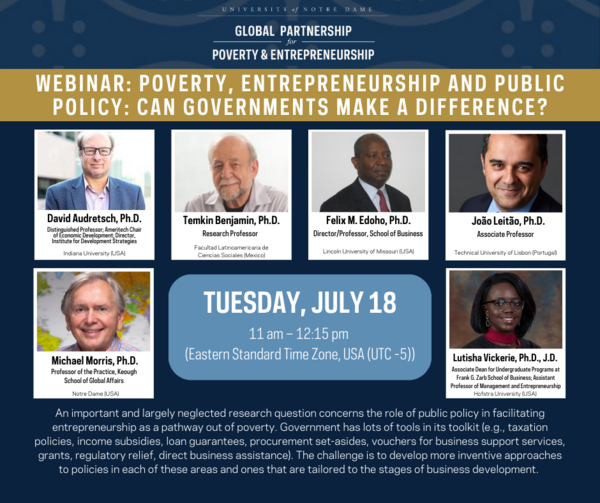
An important and largely neglected research question concerns the role of public policy in facilitating entrepreneurship as a pathway out of poverty. Government has lots of tools in its toolkit (e.g., taxation policies, income subsidies, loan guarantees, procurement set-asides, vouchers for business support services, grants, regulatory relief, direct business assistance). The challenge is to develop more inventive approaches to policies in each of these areas and ones that are tailored to the stages of business development.
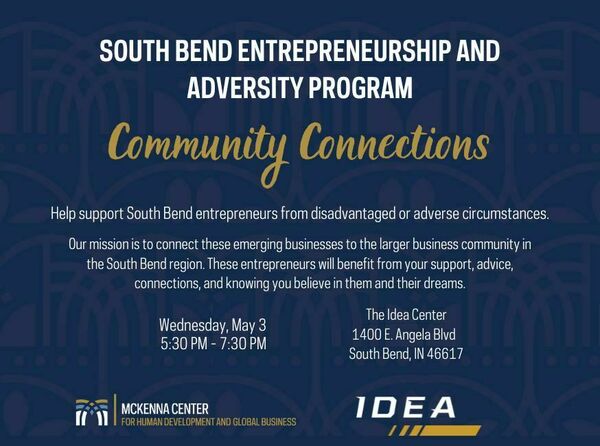
When: Wednesday, May 3rd, 5:30-7:30 PM
Where: The IDEA Center 1400 E. Angela Blvd., South Bend, IN 46617
Help support South Bend entrepreneurs from disadvantaged or adverse circumstances.
Our mission is to connect these emerging businesses to the larger business community in the South Bend region. These entrepreneurs will benefit from your support, advice, connections, and knowing you believe in them and their dreams.
When: Thursday, April 13th, 2023, 11 AM-1 PM
Where: 1050 Jenkins Nanovic Halls
Social entrepreneurship has always been with us, but in the last few decades, it has become a serious subject studied by scholars and something policy officials and community leaders across the globe have overtly attempted to facilitate. It is a field that remains incredibly diverse, with millions of social entrepreneurship initiatives operating around the globe. They come from individuals, nonprofit and community organizations, social enterprises, government entities, the private sector, and even universities.
In this special two-hour symposium, we will feature perspectives from two leading scholars in the field of social entrepreneurship, together with perspectives from social entrepreneurs operating at the community level. Social entrepreneurs address big challenges ranging from climate change and human trafficking to animal abuse and gender equality. This symposium will touch on a number of these while focusing especially on poverty and alternative solutions to its alleviation.
The question of entrepreneurship as part of the solution to global poverty is receiving increasing attention from scholars, economic development professionals, government officials, NGOs, and others. Yet, little evidence exists regarding the extent to which entrepreneurship actually moves individuals and their families out of poverty. While much of the research has been conducted in a developing country context, there is growing interest in the role of venture creation by those in poverty and disadvantaged circumstances (including many minorities, refugees, and the formerly incarcerated), in developed economies. Europe represents a case in point. In this two-hour session, three of the leading scholars in entrepreneurship and social entrepreneurship share perspectives on issues surrounding entrepreneurship as a poverty alleviation tool in Europe.